AKC Standard for the Toy Poodle with Pictures
So What Does A Toy Poodle REALLY Ought To Be Like?
Not Every Toy Poodle Is a Good Representation of the Breed!
There is this thing called the "AKC Breed Standard." It is a written out description of each pure breed according to the American Kennel Club. The "AKC Breed Standard" for the Toy Poodle describes what a Toy Poodle should really be like. This breed standard is what all reputable Toy Poodle breeders aim to produce in their lines, and this standard is also what each dog is judged by in the dog shows. I've seen videos on YouTube and Facebook that show Toy Poodles that are neurotic, have a horrible disposition, have the underbite of an English Bulldog and the short legs of a Bassethound. Sadly, they are the result of Backyard Breeding!
The Standard Poodle is the oldest of the three varieties. The words Standard, Miniature, and Toy are used to denote size only. All of these are one breed. Some use the nickname "Royal Standard" to refer to an XL Standard Poodle. The terms, "Teacup Poodle" and "Tiny Toy" are also nicknames that refer to the smallest Toy Poodles. These nicknames are not official varieties with the AKC but are just terms that describe sizes. Using or refusing to use these nicknames does not make a breeder reputable.
Poodles are known for their work retrieving capabilities in the water. In fact, many Standard Poodles are still great duck retrievers. As they were bred down in size to reach the Toy Poodle size, a few little ones still have the instict to "point" to a bird or fetch a ball. But most Toy Poodles are satisfied just being a companion lap dog.
The AKC Breed Standard for the Toy Poodle.
The Standard for the Poodle (Toy variety) is the same as for the Standard and Minature varieties except as regards heights.
General Appearance, Carriage, and Condition.
That of a very active, intelligent and elegant-appearing dog, squarely built, well proportioned, moving soundly and carrying himself proudly. Properly clipped in the traditional fashion and carefully groomed, the Poodle has about him an air of distinction and dignity peculiar to himself.
Size, Proportion, Substance.
Size
The Standard Poodle is over 15 inches at the highest point of the shoulders. Any Poodle which is 15 inches or less in height shall be disqualified from competition as a Standard Poodle.
The Miniature Poodle is 15 inches or under at the highest point of the shoulders, with a minimum height in excess of 10 inches. Any Poodle which is over 15 inches or is 10 inches or less at the highest point of the shoulders shall be disqualified from competition as a Miniature Poodle.
The Toy Poodle is 10 inches or under at the highest point of the shoulders. Any Poodle which is more than 10 inches at the highest point of the shoulders shall be disqualified from competition as a Toy Poodle.
As long as the Toy Poodle is definitely a Toy Poodle, and the Miniature Poodle a Miniature Poodle, both in balance and proportion for the Variety, diminutiveness shall be the deciding factor when all other points are equal.
Proportion.
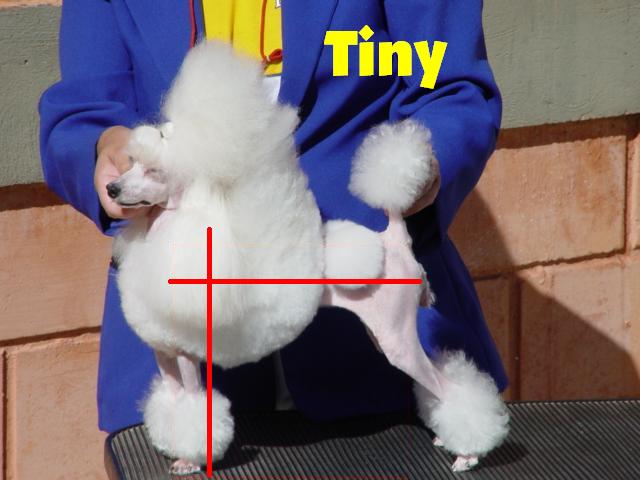
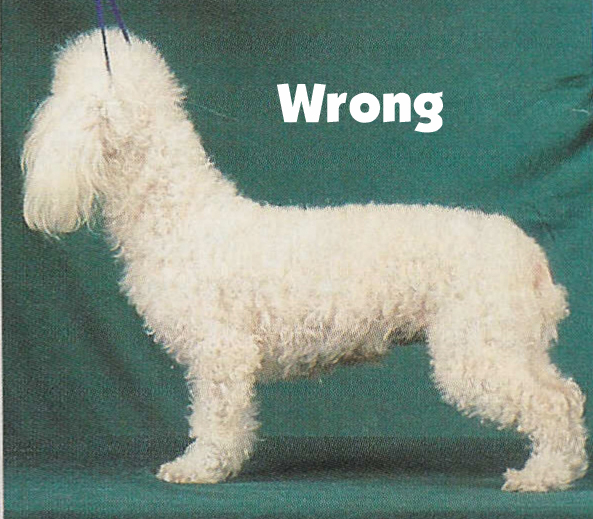
To insure the desirable squarely built appearance, the length of body measured from the breastbone to the point of the rump approximates the height from the highest point of the shoulders to the ground. (Picture: Red lines are about the same length)
 |
 |
Substance.
Bone and muscle of both forelegs and hindlegs are in proportion to size of dog.
Head and Expression.
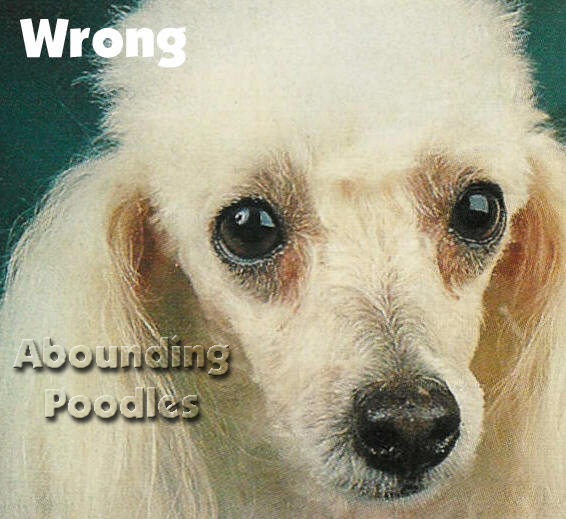
Eyes
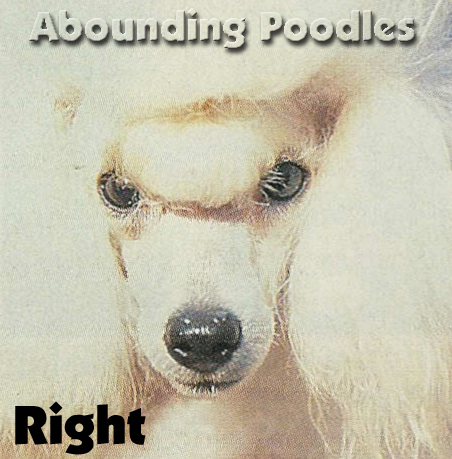
Very dark, oval in shape and set far enough apart and positioned to create an alert intelligent expression. Major fault: eyes round, protruding, large or very light.
 |
 |
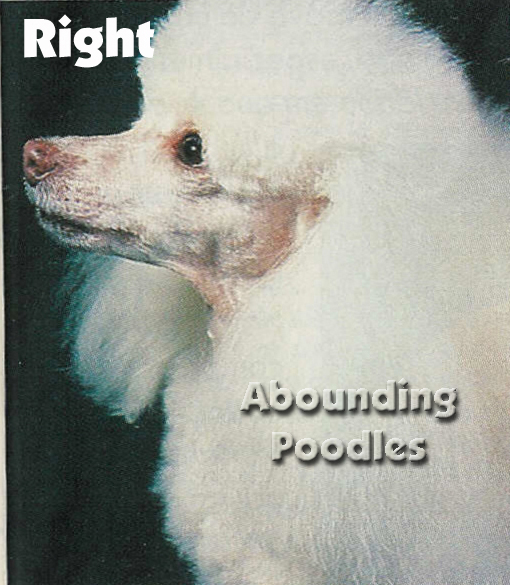
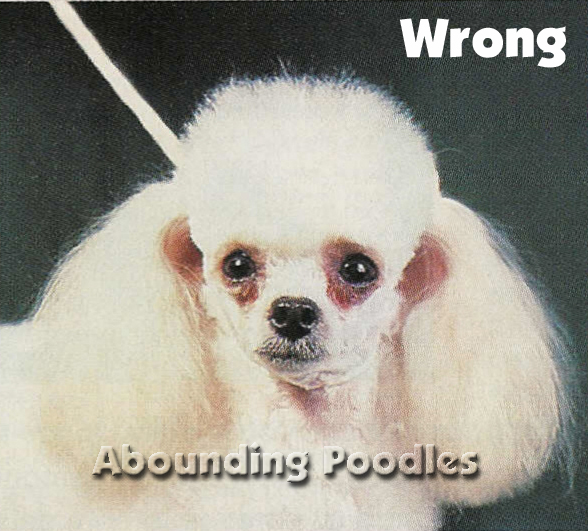
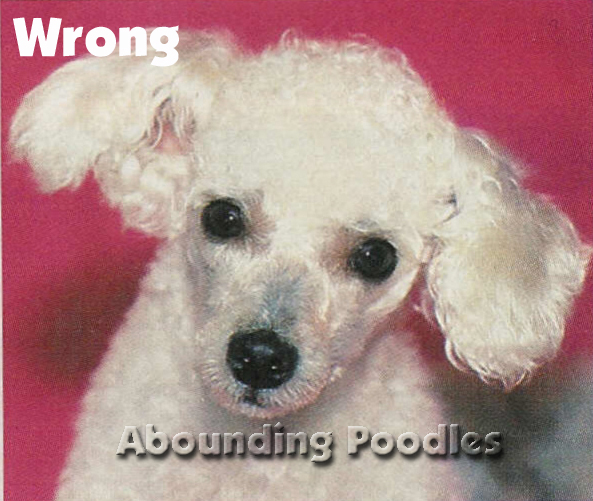
Ears
Hanging close to the head, set at or slightly below eye level. The ear leather is long, wide and thickly feathered; however, the ear fringe should not be of excessive length.
 |
 |
 |
Skull
Moderately rounded, with a slight but definite stop. Cheekbones and muscles flat. Length from occiput to stop about the same as length of muzzle.
Muzzle
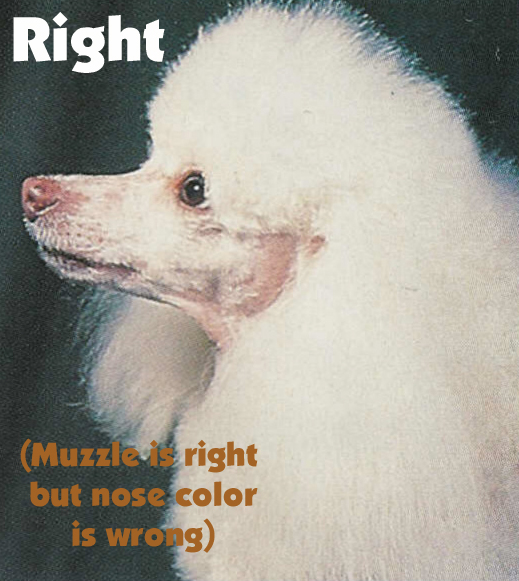
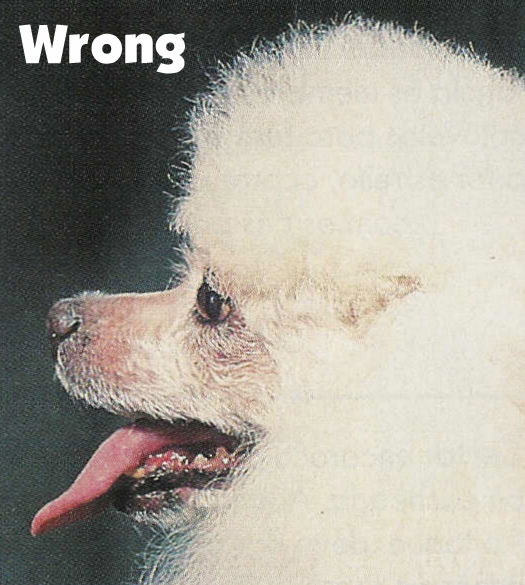
Long, straight and fine, with slight chiseling under the eyes. Strong without lippiness. The chin definite enough to preclude snipiness. Major fault: lack of chin. Teeth-- white, strong and with a scissors bite. Major fault: undershot, overshot, wry mouth.
 |
 |
Neck, Topline, Body.
Neck
Well proportioned, strong and long enough to permit the head to be carried high and with dignity. Skin snug at throat. The neck rises from strong, smoothly muscled shoulders. Major fault: ewe neck.
Topline
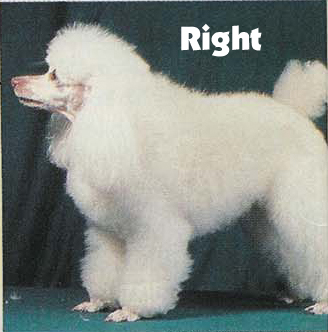
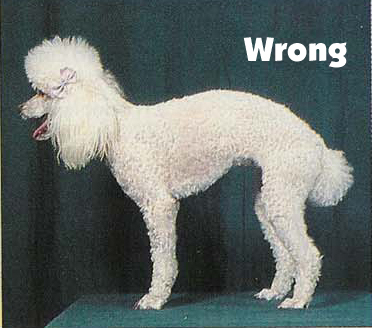
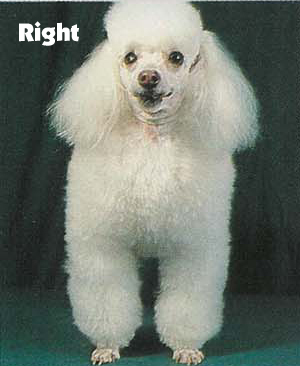
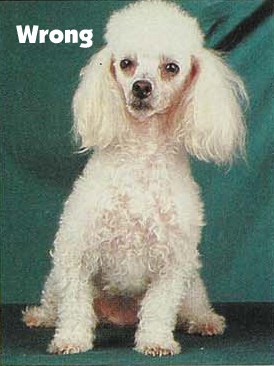
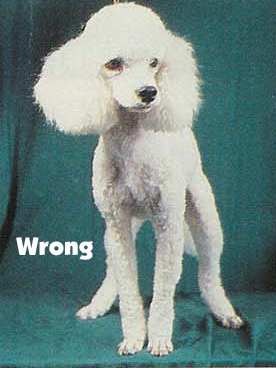
The topline is level, neither sloping nor roached, from the highest point of the shoulder blade to the base of the tail, with the exception of a slight hollow just behind the shoulder.
 |
 |
Body
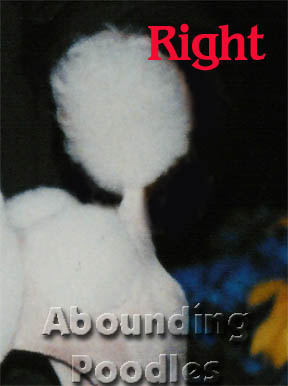
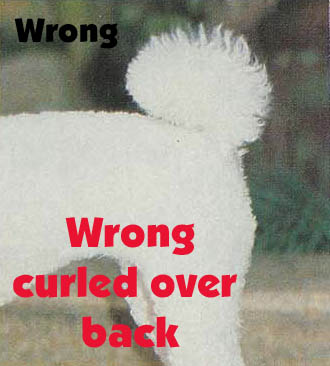
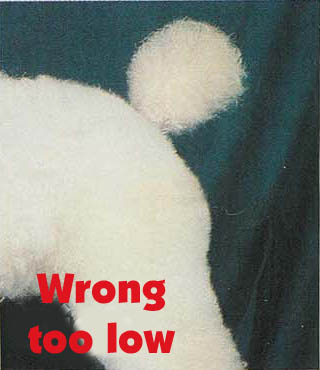
(a) Chest deep and moderately wide with well sprung ribs. (b) The loin is short, broad and muscular. (c) Tail straight, set on high and carried up, docked of sufficient length to insure a balanced outline. Major fault: set low, curled, or carried over the back.
 |
 |
 |
 |
 |
 |
Forequarters.
Strong, smoothly muscled shoulders. The shoulder blade is well laid back and approximately the same length as the upper foreleg. Major fault: steep shoulder.
(a) Forelegs
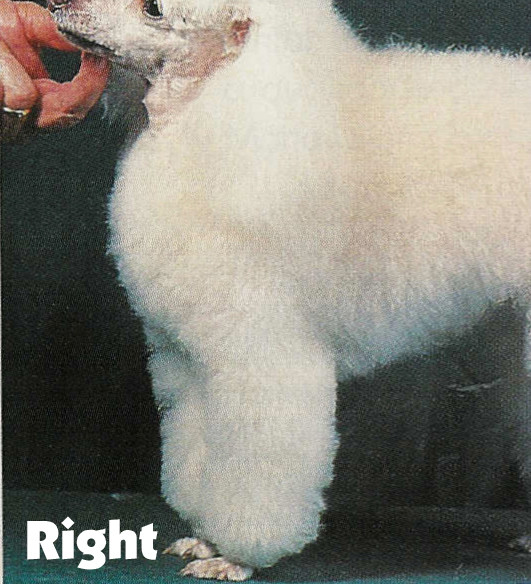
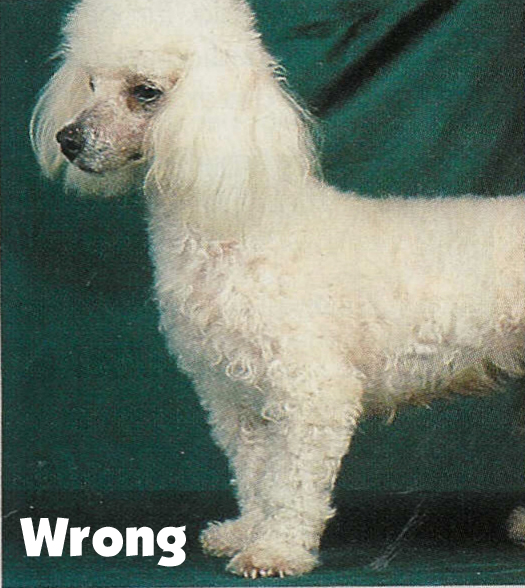
Straight and parallel when viewed from the front. When viewed from the side the elbow is directly below the highest point of the shoulder. The pasterns are strong. Dewclaws may be removed.
 |
 |
(b)Feet
The feet are rather small, oval in shape with toes well arched and cushioned on thick firm pads. Nails short but not excessively shortened. The feet turn neither in nor out. Major fault: paper or splay foot.
Hindquarters
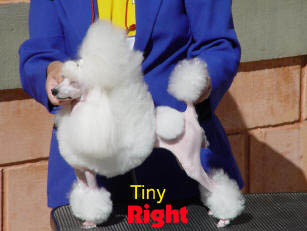
The angulation of the hindquarters balances that of the forequarters.
(a)Hind legs straight and parallel when viewed from the rear. Muscular with width in the region of the stifles which are well bent; femur and tibia are about equal in length; hock to heel short and perpendicular to the ground. When standing, the rear toes are only slightly behind the point of the rump. Major fault: cow-hocks.
 |
|
Coat
Quality
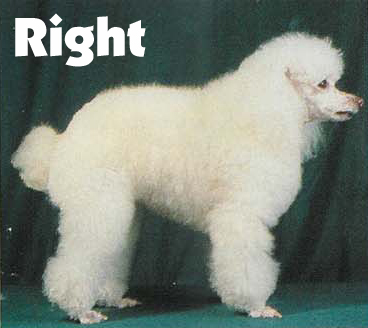
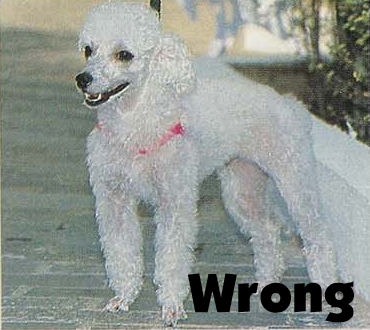
(1) Curly: of naturally harsh texture, dense throughout. (2) Corded: hanging in tight even cords of varying length; longer on mane or body coat, head, and ears; shorter on puffs, bracelets, and pompons.
 |
 |
Clip
A Poodle under 12 months may be shown in the "Puppy" clip. In all regular classes, Poodles 12 months or over must be shown in the "English Saddle" or "Continental" clip. In the Stud Dog and Brood Bitch classes and in a non-competitive Parade of Champions, Poodles may be shown in the "Sporting" clip. A Poodle shown in any other type of clip shall be disqualified.
(1) "Puppy"--A Poodle under a year old may be shown in the "Puppy" clip with the coat long. The face, throat, feet and base of the tail are shaved. The entire shaven foot is visible. There is a pompon on the end of the tail. In order to give a neat appearance and a smooth unbroken line, shaping of the coat is permissible.(2) "English Saddle"--In the "English Saddle" clip the face, throat, feet, forelegs and base of the tail are shaved, leaving puffs on the forelegs and a pompon on the end of the tail. The hindquarters are covered with a short blanket of hair except for a curved shaved area on each flank and two shaved bands on each hindleg. The entire shaven foot and a portion of the shaven leg above the puff are visible. The rest of the body is left in full coat but may be shaped in order to insure overall balance.
(3) "Continental"--In the "Continental" clip, the face, throat, feet, and base of the tail are shaved. The hindquarters are shaved with pompons (optional) on the hips. The legs are shaved, leaving bracelets on the hindlegs and puffs on the forelegs. There is a pompon on the end of the tail. The entire shaven foot and a portion of the shaven foreleg above the puff are visible. The rest of the body is left in full coat but may be shaped in order to insure overall balance.
(4) "Sporting"--In the "Sporting" clip, a Poodle shall be shown with face, feet, throat, and base of tail shaved, leaving a scissored cap on the top of the head and a pompon on the end of the tail. The rest of the body, and legs are clipped or scissored to follow the outline of the dog leaving a short blanket of coat no longer than one inch in length. The hair on the legs may be slightly longer than that on the body.
In all clips the hair of the topknot may be left free or held in place by elastic bands. The hair is only of sufficient length to present a smooth outline. "Topknot" refers only to hair on the skull, from stop to occiput. This is the only area where elastic bands may be used.
Color
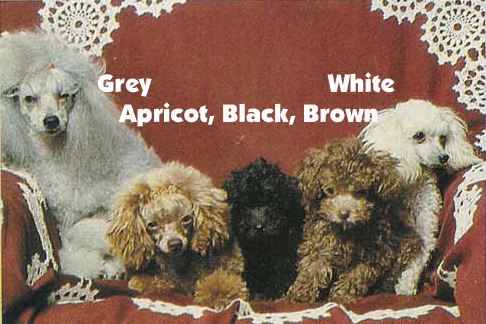
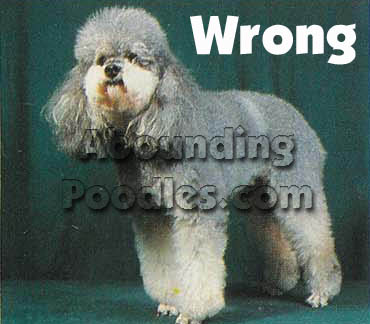
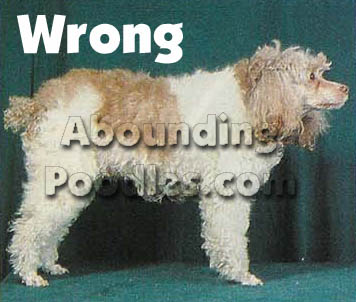
The coat is an even and solid color at the skin. In blues, grays, silvers, browns, cafe-au-laits, apricots and creams the coat may show varying shades of the same color. This is frequently present in the somewhat darker feathering of the ears and in the tipping of the ruff. While clear colors are definitely preferred, such natural variation in the shading of the coat is not to be considered a fault. Brown and cafe-au-lait Poodles have liver-colored noses, eye-rims and lips, dark toenails and dark amber eyes. Black, blue, gray, silver, cream and white Poodles have black noses, eye-rims and lips, black or self colored toenails and very dark eyes. In the apricots while the foregoing coloring is preferred, liver-colored noses, eye-rims and lips, and amber eyes are permitted but are not desirable. Major fault: color of nose, lips and eye-rims incomplete, or of wrong color for color of dog.
Parti-colored dogs shall be disqualified. The coat of a parti-colored dog is not an even solid color at the skin but is of two or more colors.
 |
 |
 |
Gait
A straightforward trot with light springy action and strong hindquarters drive. Head and tail carried up. Sound effortless movement is essential.
EXAMPLE - Watch our Tiny walk as she is a wonderful example of the Gait the AKC wants in a Toy Poodle! Click here.
Temperament
Carrying himself proudly, very active, intelligent, the Poodle has about him an air of distinction and dignity peculiar to himself. Major fault: shyness or sharpness.
Major Faults
Any distinct deviation from the desired characteristics described in the Breed Standard.
Disqualifications
Size-- A dog over or under the height limits specified shall be disqualified. Clip-- A dog in any type of clip other than those listed under coat shall be disqualified. Parti-colors-- The coat of a parti-colored dog is not an even solid color at the skin but of two or more colors. Parti-colored dogs shall be disqualified.
Value of Points
General appearance, temperament, carriage and condition.......30
Head, expression, ears, eyes and teeth.......20
Body, neck, legs, feet and tail.......20
Gait.......20
Coat, color and texture.......10
Approved August 14, 1984
Reformatted March 27, 1990
Copyright 2018. Abounding Poodles. All Rights Reserved.